
Thursday, September 03, 2020
The Left Admits It Cannot Win a Fair Fight
It relies on silencing people
If there's one thing to be said about the attempt by New York Attorney General Letitia James to dissolve the National Rifle Association, it's this: It's a concession about the Left's lack of arguments in favor of restricting our right to keep and bear arms. Don't get us wrong — this attack on the NRA is a frightening abuse of government power, and if it succeeds, the precedent could be used against other gun-rights groups at first, then expanded to just about any conservative group. But the big message is that the Left has given up on ideas in favor of sheer power to scream "shut up!"
That expansion could be what James and New York Governor Andrew Cuomo intended all along. But does anyone really think James would be trying to dissolve the NRA if she had winning arguments in favor of gun control? Would Cuomo have waged his campaign, using Parkland as a pretext, if he were successfully persuading Americans to support his anti-Second Amendment agenda?
Let's look back over the past decade and that pattern can be seen elsewhere. When the Tea Party was raising concerns about the reach of government and how much was being spent, did Barack Obama have counterarguments? If he did, he must have not been confident in their ability to carry the day. Why? The IRS instead targeted the Tea Party for harassment.
When Obama couldn't pass gun control after the horrific Sandy Hook massacre, mostly because grassroots Patriots stood up and refused to let millions of law-abiding Americans be punished for a crime they didn't commit, he didn't try to persuade Americans to rethink things, nor did he want other solutions. Instead, Operation Chokepoint was used, and a newer version, wherein companies are threatened with boycotts unless they go along with anti-Second Amendment extremists' demands, is currently being wielded. Obama, by most accounts, is a talented speaker. But why wasn't he using that rhetoric to persuade?
When conservative groups had success in Wisconsin, instead of their free speech being met with more free speech, they instead faced abusive investigations from rogue prosecutors. And while the Wisconsin Supreme Court halted the witch hunt, justice for those affected during the "John Doe" scandal remains elusive.
The arguments in opposition to radical environmental legislation were met not with counterarguments but with RICO investigations from left-wing state attorneys general. Then, of course, there is Cuomo's use of bank regulations to try to bankrupt the NRA.
When David Daleiden used typical techniques undercover journalists use (see shows like "60 Minutes" or "What Would You Do?"), the response from Planned Parenthood wasn't to use its First Amendment rights. Instead, the abortion mill sicced California's attorney general at the time, one Kamala Harris, on Daleiden.
Again, we see a pattern where counterarguments, debate, and the normal back and forth that sets our republic's course were not used. Instead, government power was brought to bear to attack one side of the debate on a hot-button issue.
We, finally, of course, get to Spygate. Again, rather than an attempt to persuade Americans, we see a resort to government power to take people out of the arena of ideas. Just last week, Judicial Watch reported that the FBI investigated Donald Trump's tweets criticizing the investigation. Can you say "retaliation"? Silly us for thinking the First Amendment protected criticism of government actions.
This pattern leads to some serious questions: Would people who had confidence in the strength of their arguments or in their powers of persuasion resort to wielding the power of government against those who dissent through the means protected by the First Amendment? Or is the pattern instead an abusive way of admitting that leftists have no defense of their agenda and no interest in the normal way of addressing good-faith disagreements over policy and principle, leading them to resort to coercion?
The cold, hard truth of the matter is that the First Amendment rights of grassroots Patriots are on the ballot this November.
SOURCE


Free speech wins out in OKC anti-panhandling case
Oklahoma City argued that safety was the goal of an ordinance that banned anyone from being in traffic medians at busy intersections. A federal appeals court didn’t buy it, in a victory for those who argued the First Amendment should prevail for people of all stripes.
In a ruling Monday declaring the city ordinance unconstitutional, a three-judge panel of the 10th U.S. Circuit Court of Appeals in Denver said the rule showed "troubling evidence of animus against panhandlers." The city council approved the ordinance in December 2015. It originally prohibited standing on traffic medians near busy intersections, and later was revised to apply to about 400 medians located within city streets with speed limits of 40 miles per hour or greater.
SOURCE
Wednesday, September 02, 2020
Big Tech needs to embrace freedom of speech
The social responsibility of Big Tech in political discourse and information dissemination is considerable. Facebook, Twitter, Google, and Apple are among the titans of Silicon Valley who have built the technological infrastructure through which we view and interpret global events.
In a time which is often characterised by political polarisation, ideological tension and rampant misinformation, these platforms are tasked with finding a balance between upholding freedom of speech and protecting their users.
They are a lens through which we view the world. And during the pandemic, with billions under lockdown across the world, for many they were the only lens through which we could view the world. So their potential to warp our perceptions of the world should be concerning for all those who value truth and democracy.
It is no secret that Silicon Valley is strongly tilted to the left. Sergey Brin, co-founder of Google, was shown in a leaked video from 2016 discussing the election of Donald Trump and concluding that ‘so many people apparently don’t share the values that we have’. Jack Dorsey, co-founder and CEO of Twitter, has said that ‘Twitter, like most tech companies in Silicon Valley, has a lot more left-leaning employees than right-leaners’. Conservative voices at Google have criticised an environment in which they feel ‘silenced’. Facebook’s oversight board is stacked with members of the left-wing establishment and had to shut down an internal group of Trump supporters due to frictions it exposed within the company.
Despite this obvious political bias, corporate leadership at these companies has tried to argue that, while their employees might be subject to political bias, this does not affect their products. Yet the premise that institutions which suppress conservative voices while amplifying liberal ones are able to remove political sentiment from their products seems improbable.
The façade of political impartiality has been further undermined by the submission of these organisations to identitarian ideology and leftist cultural narratives.
James Damore was sacked by Google after sending a memo which suggested that gender disparity in the company’s composition could be partly explained by innate differences between the sexes. He also criticised the corporation’s ‘politically correct monoculture that maintains its hold by shaming dissenters into silence’.
Twitter, which formerly branded itself the ‘free speech wing of the free-speech party’, has become emboldened to start a fight with the White House, flagging tweets from an incumbent president as ‘misleading’ and ‘glorifying violence’ during an election year.
It is difficult to accept that challenging democratically elected leaders is an entirely apolitical act. These companies have insidiously shifted from neutral platforms to content moderators. Their choices increasingly shape the debate and delineate the Overton window.
Furthermore, there is an uncomfortable acceptance of malicious and hateful content on social media when it is produced by those who belong to the left’s congregation. Particularly on Twitter, where leftists make up the majority of political accounts.
It was several days before Twitter took decisive action against the grime artist and Corbynite Wiley following his series of anti-Semitic tweets. And even then it only took action after a Twitter boycott by politicians and public figures from across the aisle.
A backlog of racist tweets from Sarah Jeong, which were circulated following her appointment to the New York Times editorial board, remains online. It seems ‘hateful content’ must be of a particular political alignment to provoke the wrath of the moderators.
It is perfectly legitimate for corporations to hold political positions. But tech and social media are different from most corporations. First, they serve as a key avenue for public debate, so in order for them to function effectively, users need to be able to speak freely. Secondly, the scale of these tech companies means they form natural monopolies. Each occupies a distinct niche within our social system. The different platforms are imperfect substitutes of each other – one cannot simply switch to Instagram if booted from Twitter.
These giants have the necessary name recognition and data infrastructure to control the flow of information in much the same way that industrial titans historically controlled the flow of natural resources. They wield enormous power over the lives of citizens while enjoying high barriers to market entry for would-be rivals. In terms of their influence on our daily lives, they are more like public utilities.
Twitter is again a good example. It has grown to a point where it is a key medium through which politicians engage with the public, journalists and activists. Even if the Twittersphere is not really representative of the broader electorate, messages are disseminated broadly through the platform. Twitter’s decision to modify that engagement thus warps political discourse.
It follows that we should hold Big Tech to a different standard. Principles like political neutrality and free speech should be protected more fiercely given the danger of warping our perceptions. Yet there has been a decline in the protection of political neutrality and free speech. And this has coincided with, and has been accelerated by, the culture wars that we see playing out in our universities and public squares and the mainstream media.
Free speech is generally considered a nice idea but a less important one than the preservation of ‘safe spaces’ in which victims of oppression must be protected from ‘harmful’ or ‘hateful’ conduct. Belief in free speech as an absolute and fundamental right has become increasingly conditional on the content of that speech, and deplatforming has emerged as a natural consequence.
To those on the left who subscribe to these ideals, deplatforming is now seen as an effective means of silencing critics. The underlying assumption is that those who are banished from one platform for airing their politically unpalatable views will retreat from public discussion and into internal reflection. In fact, those pushed out will generally just move to new platforms with less restrictive practices, like Parler, Gab and Telegram. The net result is political siloing, not repentance.
Furthermore, the judgements made by Big Tech are generally opaque and their reasoning unclear. Where we have been able to peek inside their internal processes, the findings are concerning. Facebook’s ever-growing rules for content-policing run to 1,400 pages. The incoherent sprawl of rules has the feel of an ideology desperately scrambling to build consistency on an internally contradictory set of principles. They are playing a game of linguistic whack-a-mole as they try to decide what can and cannot be said.
Given the global reach of these corporations, the attempt to find a one-size-fits-all approach to questions that are essentially moral is impossible. Networks that spread across nations, ideologies, religions and cultures are inevitably forced into internal contradictions as they attempt to satisfy all. Utopian visions of universal content standards do not mix well with reality.
Try as they might, these companies are further undermined by their hypocrisy. Google, like many other tech companies, preaches diversity and yet has built an employee base that is largely unrepresentative. These organisations are attempting a top-down restructuring of society and yet they are unable to get their own houses in order.
These corporations have also been remarkably willing to bend their principles to the wishes of authoritarian states. We have social networks that will ban users for saying ‘men aren’t women’ while being entirely comfortable catering to the requests of repressive regimes.
The enormous power of tech giants to shape public discourse has so far presupposed political neutrality. There is increasing evidence that these platforms are happy to reshape their processes according to political ideology. Free speech has taken the back seat as content is policed for ill-defined ‘hateful content’.
With their growing influence over political processes, they will face two options. As societies recognise the threat posed to democracy by tech giants, they will likely face more calls for regulation and government intervention. Or they can themselves take responsibility for encouraging an open, liberal approach. The only morally coherent, politically acceptable and practically achievable solution is for platforms to embrace freedom of speech, however difficult that might be.
SOURCE
Adele’s tribute to Notting Hill Carnival sparks culture row
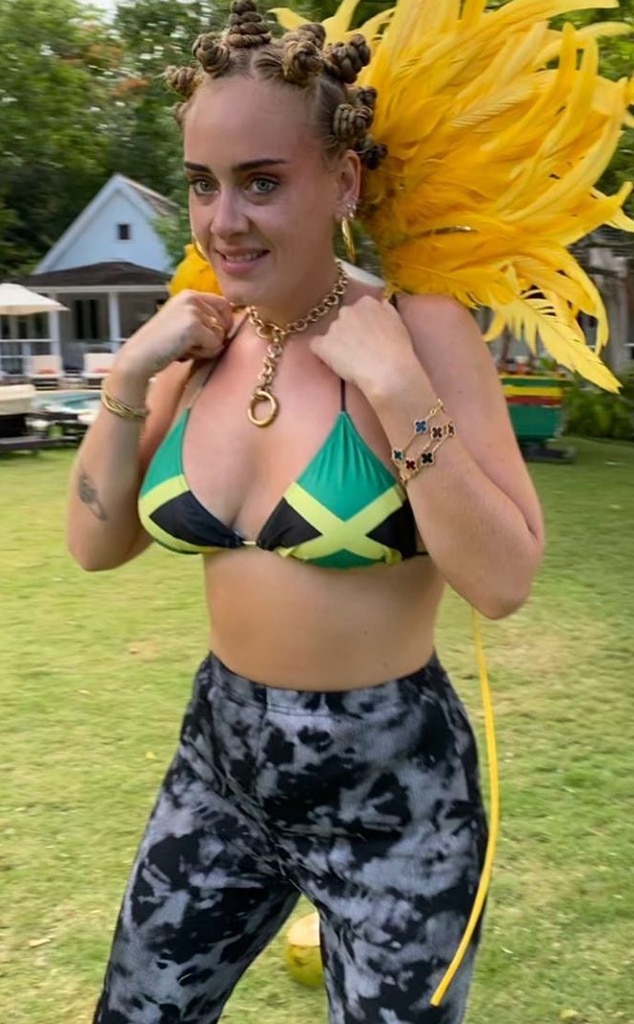
It just looks weird to me. But she has done wonders in getting slim
Adele has been accused of cultural appropriation after sharing a photo of herself with her hair in a traditional African hairstyle to mark Notting Hill Carnival.
The singer wore a bikini printed with the Jamaican flag, a feathered collar and headpiece, and her blonde hair in bantu knots, a traditional African hairstyle.
She posted the picture on Instagram with he caption: “Happy what would be Notting Hill Carnival, my beloved London”.
The image sparked complaints on social media. One user wrote: “Black women are discriminated against for wearing cultural hairstyles like bantu knots and locs but white people are not, that’s not fair and that’s why people are pissed off.”
SOURCE
Tuesday, September 01, 2020
University Shouldn’t Punish Me for Not Addressing Male Student as ‘Ms.’
Returning from a sabbatical in my 21st year at Ohio’s Shawnee State University, I resumed teaching my regular political philosophy course.
Taking questions in one such class at the end of my first day back, I acknowledged a male student with a “Yes, sir?” (It’s my practice to address my students in this way and to call them Miss, Mrs., or Mr. to foster an atmosphere of seriousness and mutual respect.)
After class, the student approached me to explain that he identifies as a woman and hereafter expected me to refer to him with feminine titles and pronouns.
“I’m not sure I can do that,” I told him.
He didn’t like that. He began to pace in circles around me, his voice rising and taking on an edge. He suggested an unprintable name he might feel free to call me if I declined to indulge his demands. Moreover, he said, he would see to it that I lost my job.
So far, that hasn’t happened, but I do have a letter of discipline in my file now that says I treated this particular student differently than other students by referring to him by his given name rather than as “Ms.” and “she.”
That’s all. No other allegations of hostile conduct or even of an unfair grade for the student were ever filed.
Consequently, I found it necessary to file a grievance against the university for violating my First Amendment protections of speech and religious freedom. My objections to the student’s request were based on my own philosophical and religious convictions, which the university blithely ignored.
I also believe I should have a certain amount of freedom, within my own classroom, to determine the exact language I do and do not use when teaching my class. The university denied me that freedom, as well. And it also denied my grievance.
That left me with no choice but to file suit through my Alliance Defending Freedom attorneys. Contrary to claims, such as those recently made by law professor Andrew Koppelman of Northwestern University, that I was simply “spoiling for a fight” and that my “arguments are so extravagant that they shouldn’t be worthy of notice,” all professors should be free to respectfully exercise their First Amendment rights.
They should not be compelled to say and teach things they don’t believe or risk being fired or disciplined. And everyone should be free to stand thoughtfully for the truth.
My letter of discipline notwithstanding, the school’s problem with me—and, for that matter, the student’s problem with me—is not really that I treated him differently, but that I did not. I treated this student exactly like I treat others, when in fact he wanted to be treated differently.
He demanded to be referred to as a woman. Though I could not in good conscience do that, I did offer to make an exception and refer to him by his given name, rather than either “Mr.” or “Ms.,” but, again, that wasn’t what he wanted. Nor was it, once his preference was stated, what the university administrators wanted for him.
“But,” many would say, “he has the right to identify as a woman if he wants to.” Perhaps, but I also have a right not to identify him as something I do not believe he is.
He has his beliefs, and I have mine. I can’t compel him to speak like me, and neither he nor the university should be trying to compel me to speak like him.
SOURCE
Returning from a sabbatical in my 21st year at Ohio’s Shawnee State University, I resumed teaching my regular political philosophy course.
Taking questions in one such class at the end of my first day back, I acknowledged a male student with a “Yes, sir?” (It’s my practice to address my students in this way and to call them Miss, Mrs., or Mr. to foster an atmosphere of seriousness and mutual respect.)
After class, the student approached me to explain that he identifies as a woman and hereafter expected me to refer to him with feminine titles and pronouns.
“I’m not sure I can do that,” I told him.
He didn’t like that. He began to pace in circles around me, his voice rising and taking on an edge. He suggested an unprintable name he might feel free to call me if I declined to indulge his demands. Moreover, he said, he would see to it that I lost my job.
So far, that hasn’t happened, but I do have a letter of discipline in my file now that says I treated this particular student differently than other students by referring to him by his given name rather than as “Ms.” and “she.”
That’s all. No other allegations of hostile conduct or even of an unfair grade for the student were ever filed.
Consequently, I found it necessary to file a grievance against the university for violating my First Amendment protections of speech and religious freedom. My objections to the student’s request were based on my own philosophical and religious convictions, which the university blithely ignored.
I also believe I should have a certain amount of freedom, within my own classroom, to determine the exact language I do and do not use when teaching my class. The university denied me that freedom, as well. And it also denied my grievance.
That left me with no choice but to file suit through my Alliance Defending Freedom attorneys. Contrary to claims, such as those recently made by law professor Andrew Koppelman of Northwestern University, that I was simply “spoiling for a fight” and that my “arguments are so extravagant that they shouldn’t be worthy of notice,” all professors should be free to respectfully exercise their First Amendment rights.
They should not be compelled to say and teach things they don’t believe or risk being fired or disciplined. And everyone should be free to stand thoughtfully for the truth.
My letter of discipline notwithstanding, the school’s problem with me—and, for that matter, the student’s problem with me—is not really that I treated him differently, but that I did not. I treated this student exactly like I treat others, when in fact he wanted to be treated differently.
He demanded to be referred to as a woman. Though I could not in good conscience do that, I did offer to make an exception and refer to him by his given name, rather than either “Mr.” or “Ms.,” but, again, that wasn’t what he wanted. Nor was it, once his preference was stated, what the university administrators wanted for him.
“But,” many would say, “he has the right to identify as a woman if he wants to.” Perhaps, but I also have a right not to identify him as something I do not believe he is.
He has his beliefs, and I have mine. I can’t compel him to speak like me, and neither he nor the university should be trying to compel me to speak like him.
SOURCE
Ben Shapiro loses free speech lawsuit against UMN over venue change
A U.S. district judge ruled that the University had legitimate safety concerns when it moved the venue of Shapiro's July 2018 campus speech to St. Paul.
A judge determined Friday that University of Minnesota officials were driven by safety concerns in conservative speaker Ben Shapiro’s freedom of speech lawsuit, according to the Pioneer Press.
Shapiro and the groups that sponsored his campus visit – Young America's Foundation and Students for a Conservative Voice – filed a lawsuit in July 2018, alleging that the University held the event on a smaller venue on the St. Paul campus instead of a larger venue on the Minneapolis campus due to political bias.
“As a result of the forced relocation to the [North Star] Ballroom, many students were prevented from attending and participating in the speaking event, and Shapiro was forced to speak to less than half the number of students that desired to attend,” read the lawsuit.
U.S. District Judge Susan Richard Nelson ruled the University had legitimate safety concerns after Shapiro events at other universities inspired hundreds of people to protest, the Pioneer Press reported.
“Consistent with the law that governs ‘limited public forums,’ University officials put reasonable restrictions in place to insure the event was secure,” Nelson wrote.
SOURCE
Monday, August 31, 2020
Sasha White and the woke war on feminists
Imagine the horror of having a literary agent who might not want to use your preferred pronouns. To raise awareness of this burning issue, on 24 August, a ‘genderfluid’ writer called Madeline Pine organised a Twitter campaign with other gender-soggy activists to target literary assistant Sasha White. Pine tweeted: ‘My pronouns are they / them… Sasha White is a publishing agent who doesn’t believe in honouring my pronouns.’
Hundreds of social-justice warriors joined in, apparently feeling quite justified in publicly hounding a woman for doing nothing more than holding an unpopular point of view.
Earlier this week, Sasha White was still an employee at the Tobias Literary Agency (TLA). She was tweeting in a personal capacity from her own account @iamGrushenka, while she used @SashaSemonovna for more professional tweets. Along with expressions of support for disgraced author JK Rowling, White posted as @iamGrushenka: ‘The reason I think pronouns suck is because thinking of people as “they / them” and pretending they’re not male or female is like colour / race blindness for gender. It won’t help sexism or toxic masculinity. Men and women have unique and distinct experiences…’
Her observation is valid: the 23million female fetuses aborted due to the cultural preference for boys in India and China will not be able to identify out of their fate; the women imprisoned in Iran for protesting against forced veiling can’t declare themselves men and claim their freedom; and the victims of grooming gangs in Rochdale wouldn’t have been saved by declaring themselves ‘genderfluid’.
It is true that identity politics has become an all-consuming monster. Nonetheless, as with race and class, the sex you are born into does change how you experience life and it is important that language allows us to articulate these differences. That a minority of self-pitying, privileged brats demand the use of ‘they / them’ pronouns does nothing to alter the material reality of social inequality.
The fact that White’s comment was reasonable, evidenced-based and expressed as a personal opinion offered her no protection. Within an hour, TLA had issued a statement decrying her views as ‘anti-trans’. In the same afternoon, following trial by social media, White tweeted to announce: ‘It’s true: I was fired last night for my feminist stance. The Twitter mob came for me and my employer immediately terminated me.’
SOURCE
Imagine the horror of having a literary agent who might not want to use your preferred pronouns. To raise awareness of this burning issue, on 24 August, a ‘genderfluid’ writer called Madeline Pine organised a Twitter campaign with other gender-soggy activists to target literary assistant Sasha White. Pine tweeted: ‘My pronouns are they / them… Sasha White is a publishing agent who doesn’t believe in honouring my pronouns.’
Hundreds of social-justice warriors joined in, apparently feeling quite justified in publicly hounding a woman for doing nothing more than holding an unpopular point of view.
Earlier this week, Sasha White was still an employee at the Tobias Literary Agency (TLA). She was tweeting in a personal capacity from her own account @iamGrushenka, while she used @SashaSemonovna for more professional tweets. Along with expressions of support for disgraced author JK Rowling, White posted as @iamGrushenka: ‘The reason I think pronouns suck is because thinking of people as “they / them” and pretending they’re not male or female is like colour / race blindness for gender. It won’t help sexism or toxic masculinity. Men and women have unique and distinct experiences…’
Her observation is valid: the 23million female fetuses aborted due to the cultural preference for boys in India and China will not be able to identify out of their fate; the women imprisoned in Iran for protesting against forced veiling can’t declare themselves men and claim their freedom; and the victims of grooming gangs in Rochdale wouldn’t have been saved by declaring themselves ‘genderfluid’.
It is true that identity politics has become an all-consuming monster. Nonetheless, as with race and class, the sex you are born into does change how you experience life and it is important that language allows us to articulate these differences. That a minority of self-pitying, privileged brats demand the use of ‘they / them’ pronouns does nothing to alter the material reality of social inequality.
The fact that White’s comment was reasonable, evidenced-based and expressed as a personal opinion offered her no protection. Within an hour, TLA had issued a statement decrying her views as ‘anti-trans’. In the same afternoon, following trial by social media, White tweeted to announce: ‘It’s true: I was fired last night for my feminist stance. The Twitter mob came for me and my employer immediately terminated me.’
SOURCE
Google bias
You’d think we’re living in a dystopian novel: news sites are blocked, politicians are prevented from reaching constituents, speech is arbitrarily labeled as “false,” and history is “forgotten.” But this isn’t Orwell’s Airstrip One in 1984. It’s America in 2020.
You don’t need to be a conspiracy theorist to see this in action. In late July, Breitbart and other websites that support the Trump administration mysteriously disappeared from Google's search results, leading some to believe that Google might maintain a “blacklist” of disfavored websites that it either buries or outright blocks from its search results. We wanted to see if this was true, so we conducted a search for the terms “Azar” and “Taiwan” on both Google and DuckDuckGo, a Google competitor focused on user privacy. For context, Secretary of Health and Human Services Alex Azar recently visited Taiwan.
The results were unsurprising, but still disappointing. A Breitbart story detailing the event ranked ninth in the DuckDuckGo search. On Google, the story didn’t even break the top 50. Keep in mind, Breitbart consistently drives traffic to its website and user engagement on social media, and ranks higher in Amazon’s Alexa website rankings than either NBC News or The Wall Street Journal.
If Google were a small search engine, this sort of bias in its results might not matter. But Google dominates online search. Globally, across all platforms, Google enjoys a 92% market share.
SOURCE
Sunday, August 30, 2020
A recent case of attempted silencing and censorship has roiled the field of political science
Two gender studies professors, Allison Howell of Rutgers University and Melanie Richter-Montpetit of the University of Sussex in the UK, wrote an interdisciplinary paper titled “Is securitization theory racist? Civilizationism, methodological whiteness, and antiblack thought in the Copenhagen School,” published in the journal Security Dialogue.
Howell and Richter-Montpetit argued a predictable view in interdisciplinary scholarship: Securitization theory is Eurocentric and, therefore, structurally racist, promoting the usual sins of “civilizationism, methodological whiteness, and antiblack racism.” Broadly, securitization theory divides the world as “(white) ‘civilized politics’ against (racialized) ‘primal anarchy.’”
The paper, a direct attack against the Copenhagen School of Securitization theory, naturally drew a tough response from the theorists Barry Buzan of the London School of Economics and Ole Waever of the University of Copenhagen. But that is where the fun started.
First, they were refused space to respond to the libelous paper—which accused them of racism and Eurocentrism—and eventually offered some small space which was clearly inadequate. Buzan and Waever then wrote a short reply, while linking to a more thorough dissection of the original scholarship and its methodological flaws.
Howell and Richter-Montpetit then started, predictably, a Kafkaesque open letter campaign where they claimed that the critique of them amounted to intimidation against junior scholars, and therefore needed a public denouncement.
For the historical record, Buzan and Waever’s rebuttal is exemplary scholarship in picking apart scholarly libel and a shoddy, “at times, pernicious” methodology. Beyond their personal disappointment, they wrote that they are more concerned about the “implications for our discipline that an article of such poor academic quality and problematic political content can be published in one of our leading journals.”
The charges are toxic and unsupported, and the methodology is termed as “deep-fake;” it cherry-picks words and phrases to construct a grand narrative of racial theory-building without any sense of the concept being critiqued. “If H&RM deem various classical authors (Arendt, Schmitt, Hobbes, Durkheim, Foucault) as being racist, then we and ST are racist too for citing them,” Buzan and Waever write. “This destructive tactic is the main basis for their charge against us of civilizationism.”
SOURCE
Media Figures Smear Nick Sandmann as a ‘Snot-Nosed,’ ‘Smug,’ ‘Tiny Nazi’
On August 25, Sandmann, the Covington Catholic High School graduate who sued media outlets for defamation after their coverage of an interaction between him and Native American activist Nathan Phillips, spoke at the Republican National Convention. He drew attention to biased media and urged that journalists be held accountable. Following his comments, media figures and political activists called him everything from “snot-nosed” to a “tiny Nazi.”
Sandmann, a Kentucky native, sued outlets including the Washington Post, The New York Times, and CNN after he and his classmates, many of whom wore pro-Trump hats, were cast as racist instigators.
"I’m the teenager who was defamed by the media after an encounter with a group of protestors on the steps of the Lincoln Memorial last year," Sandmann introduced himself at the RNC.
After attending the March for Life in defense of the unborn, he said he purchased a Make America Great Again hat because President Trump “has distinguished himself as one of the most pro-life presidents.”
“Looking back now, how could I have possibly imagined that the simple act of putting on that red hat would unleash hate from the left and make myself the target of network and cable news networks nationwide?" he asked. “I found myself face-to-face with Nathan Phillips and other professional protestors looking to turn me into the latest poster child showing why Trump is bad.”
Even now, Sandmann is a media target. Following his speech, commentators and political figures personally attacked the teenager.
One of the most attention-grabbing comments came from CNN political analyst Joe Lockhart, who tweeted, “i don't have to watch this snot nose entitled kid from Kentucky.”
After a backlash, Lockhart ironically complained about the “personal attacks” that he himself had received for his earlier tweet.
SOURCE
Friday, August 28, 2020
EFF Sues Texas A&M University Once Again to End Censorship Against PETA on Facebook and YouTube
This week, EFF filed suit to stop Texas A&M University from censoring comments by PETA on the university’s Facebook and YouTube pages.
In light of the COVID-19 pandemic, Texas A&M held its spring commencement ceremonies online, with broadcasts over Facebook and YouTube. Both the Facebook and YouTube pages had comment sections open to any member of the public—but administrators deleted comments that were associated with PETA’s high-profile campaign against the university’s muscular dystrophy experiments on golden retrievers and other dogs.
Where government entities such as Texas A&M open online forums to the public, the First Amendment prohibits them from censoring comments merely because they don’t like the content of the message or the viewpoint expressed. On top of that, censoring comments based on their message or viewpoint also violates the public’s First Amendment right to petition the government for redress of grievances.
Texas A&M knows this well, because this is not the first time we’ve sued them for censoring comments online. Back in 2018, EFF brought another First Amendment lawsuit against Texas A&M for deleting comments by PETA and its supporters about the university’s dog labs from the Texas A&M Facebook page. This year, in a big win for free speech, the school settled with PETA and agreed to stop deleting comments from its social media pages based on the comments’ messages.
We are disappointed that Texas A&M has continued to censor comments by PETA’s employees and supporters without regard for the legally binding settlement agreement that it signed just six months ago, and hope that the federal court will make clear to the university once and for all that its censorship cannot stand.
SOURCE
Most Americans think social media companies are censoring people
Because they are
Facebook, YouTube, Twitter, and other social media companies are scrambling to take down and fact-check rampant misinformation about topics like Covid-19 and the 2020 election that spread on their platforms.
But complicating these companies’ efforts to moderate content is the fact that a majority of Americans — on both sides of the political aisle — believe that social media companies are censoring political viewpoints, according to a new poll by the Pew Research Center.
About three in four Americans feel it is very likely or somewhat likely that social media sites “intentionally censor political viewpoints that they find objectionable,” according to the survey. It polled around 4,700 Americans across the political spectrum. While people from both parties thought that social media companies were likely censoring content for political reasons, Republicans were much more likely than Democrats — 90 percent of Republicans compared to 59 percent of Democrats — to hold this belief.
SOURCE
Thursday, August 27, 2020
Australia: Cancel culture and push to rename Queensland’s ‘racist’ place names must end now, writes Michael Madigan
Today we in Queensland are pondering the (hopefully faint) possibility that we will have to rename a series of Queensland cities and towns because they are allegedly named after people connected to slavery.
A petition from 400 people lodged with the Queensland Parliament has requested the move start with Russell Island – named for Lord Russell who allegedly voted against slavery abolition
Townsville, Mackay and Gladstone are just some of the places named after figures who supported the blackbirding which often resulted in South Sea Islander forced to work in sugar cane paddocks under appalling conditions for meagre, or sometimes no, wages.
The Palaszczuk Government says it will consider changing names associated with British aristocrats and politicians who were in favour of slavery.
Yet if we start walking down this track we’ll find it has no end, no point of finality.
For, if we were to be logical and consistent, we would have to start by renaming the entire state of Queensland. The “Queen’s Land’’ is quite definitely named after the British Monarch generically even if the name originated in the time of Queen Victoria.
And it was a British Queen (Elizabeth 1) who in 1563 helped kick off the African slave trade when she rented out one of her old man’s (Henry VIII) boats (it was called ironically enough, Jesus of Lubeck) to a group of British businessman who collected African slaves.
So the institution that is the British Monarchy is tainted with slavery and the very name of this state, by association, also carries the stain.
Yet it was also members of the British Monarchy (notably Prince Augustus Frederick, Duke of Sussex, now a title owned by Prince Harry) who joined the abolitionists led by William Wilberforce in the 19th Century to bring an end to slavery.
Places named after slave traders and their supporters:
Townsville - named after Robert Towns - revived blackbirding in Queensland in the late 19th Century
Mackay - named after Captain John Mackay - conducted many blackbirding expeditions through the Pacific and China between 1865 and 1883
Gladstone - named after British prime minister William Gladstone - supported the slave trade
Town of McIlwraith, McIlwraith Range - named after three-time Queensland Premier between 1879 and 1893 - tried to annex New Guinea for Queensland to promote easy flow of slave labour, supported the trade
Federal division of Dickson - Brisbane northside seat named after Sir James Dickson, currently held federal MP Peter Dutton - supported the trade of slaves to Queensland
William Gladstone’s family may have owned slaves, and he may have been an apologist for slaves, but he also attempted to rein in some of the more brutal treatment of the Irish.
Captain John Mackay may have engaged in blackbirding but he also led an expedition up from what is now northern New South Wales to present day Mackay.
That opened up the district to the agriculture which played a major role in developing the economy of present day Queensland.
As for Russell Island, a reader of The Courier-Mail has already penned a letter to the editor saying the allegations of Lord John Russell supporting slavery are simply wrong.
That Lord Russell was apparently not even born when his father Lord Russell made a speech supporting the regulation of the slave trade.
We just can’t go on doing this. We can’t go on posturing as moral arbiters of people who lived in times we can’t possibly understand.
And we can’t go on attacking people connected with slavery when almost every society on planet earth, for thousands of years, thought slavery perfectly acceptable.
Our own behaviour, which we might assume is perfectly acceptable, may be interpreted as utterly reprehensible by generations living a century on from today.
All we can hope is that future generations have the intelligence to understand that human beings are fallible, and the wisdom to know they share in that fallibility.
Brian Courtice is a former federal Labor politician from Bundaberg who knows more about the South Sea Islander blackbirding trade than most people in this state after studying it for decades.
His own property outside Bundaberg hosts the bodies of South Sea Islander who were often buried in the cane fields, where they fell.
Courtice, who has formally asked the British Government for an apology relating to the blackbirding trade which occurred under British rule, says changing a name or tearing down a statue resolves nothing.
“What we need is more statues, more place names,’’ he says.
“We need to own all of our history, not just part of it.’’
SOURCE
NBC Sports REMOVES analyst Mike Milbury for making 'insensitive' joke that NHL players were lucky they had 'no women to disrupt their concentration' in the playing bubble
Just a normal sort of joke you hear among men
NBC Sports have removed National Hockey League analyst Mike Milbury for making an 'insensitive' and 'insulting' comment about women.
On Thursday, the 68-year-old sparked furor for making the off-color remark during a live broadcast of a game between the New York Islanders and Washington Capitals.
After fellow commentator, Brian Bouche, mentioned the NHL's 'quarantine bubble', Milbury quipped: 'There's not even any woman here to disrupt your concentration'.
The comment caused a storm on Twitter, and Milbury was quickly blasted by the NHL.
In a statement released on Friday, the organization said: 'The National Hockey League condemns the insensitive and insulting comment that Mike Milbury made during last night's broadcast and we have communicated our feelings to NBC.
'The comment did not reflect the NHL's values and commitment to making our game more inclusive and welcoming to all'.
Milbury apologized for his comments in a statement released through NBC. 'It was not my intention to disrespect anyone. I was trying to be irreverent and took it a step too far. It was a regrettable mistake that I take seriously,' he said.
However, the apology didn't appear to be enough for the broadcaster, who booted the analyst from covering its Friday games.
Many social media users described Milbury's remarks as 'offensive' and 'outdated'.
However, others claimed it was simply a storm in a teacup.
SOURCE
Wednesday, August 26, 2020
BBC 'is considering dropping Rule Britannia and Land of Hope and Glory from Last Night of the Proms in wake of BLM protests'
This is sacrilegious. These songs are immensely enjoyed and are undoubtedly the highlight of the Proms. But patriotism is "racist" if not "white supremacist" these days of course
British anthems: Rule, Britannia and Land of Hope and Glory could be axed from the BBC Proms amid the Black Lives Matter movement, an insider has claimed.
The broadcaster is considering dropping the patriotic songs from the Last Night concert due to fears of criticism because of their apparent links to colonialism and slavery, the Times reported.
Dalia Stasevska, who is conducting the Last Night on September 12, is said to believe 'a ceremony without an audience is the perfect moment to bring change.'
'Dalia is a big supporter of Black Lives Matter,' a source added.
Flag-waving crowds will be absent from London's Royal Albert Hall during the 125th annual Last Night of the Proms concert due to the coronavirus outbreak.
Jan Younghusband, head of BBC music TV commissioning, has confirmed the content of the Last Night concert is still under review.
She said: 'We have a lot of problems about how many instruments we can have. It is hard to know whether it is physically possible to do [Rule Britannia].
Its inclusion in the Last Night was previously criticised by BBC columnist Richard Morrison, who put out a call for Rule, Britannia and Land of Hope and Glory to be scrapped from the concert because they are 'crudely jingoistic'.
Last month, Mr Morrison used his column in the BBC Music Magazine to claim it would be 'insensitive, bordering on incendiary' to chant the 'nationalist' songs this year in the wake of the Black Lives Matter movement.
He took aim at the traditional patriotic pieces, and called for a 'toe-curling embarrassing anachronistic farrago of nationalistic songs' to be replaced with a 'more reflective' finale which doesn't 'provoke offence or ridicule' - but stopped short of proferring any suggestions.
BBC Proms director David Pickard said: 'These are challenging times for our nation and the rest of the world, but they show that we need music and the creative industries more than ever.
'This year it is not going to be the Proms as we know them, but the Proms as we need them.
SOURCE
Jokes not allowed

It's a play on the expression "shotgun wedding"
A hunting-themed wedding cake that shows a bride holding a rifle under her arm while dragging her groom's body is being slammed online, as critics call it 'trashy' and 'gross.'
A photo of the custom cake was posted on Reddit's Wedding Shaming forum, with the person who shared it writing: 'Immediately no. Immediately no.' While the design was beautifully executed, many agreed the theme was in poor taste.
'The hunt is over,' reads the sign on the front of the cake, which shows a bride in her wedding gown pulling her camouflage-wearing husband-to-be away with a hunting a rifle tucked under her arm.
The intricate cake by Graceful Cake Creations was decorated to look like a tree stump, with a deer, two large bullets, and fall leaves surrounding the bride and groom.
The backlash was directed at the couple who ordered the cake, with a number of commenters pointing out that the design itself was well-done.
'A trashy idea, but well-executed,' one person wrote. 'Can't say it's a graceful wedding cake though...'
'10/10 Bakers Points for the execution, but 0/10 What the French Fried F**ks for the content,' someone else wrote. 'This could be funny if Cupid had a compound bow and both bride and groom were struck by Arrows of Love or somesuch, but this "bride murders groom" thing is over the top gross.'
'At least the groom isn’t bloody?' another added.
SOURCE
Tuesday, August 25, 2020
Australian public servant condemns censorship after blogpost cost him his job
He would have had to sign a confidentiality agreement to get his job so the government has a clear right to enforce that agreement. But whether what he did does breach the agreement sounds moot. But in any case there is no "right" to a government job. And resigning was not forced on him. So I think he has scant grounds for complaint
When federal public servant Josh Krook sat down to pen a decidedly uncontroversial blogpost on how Covid-19 benefitted big tech, he didn’t imagine it would cost him his job.
In April, Krook published a post on a fledgling blog called the Oxford Political Review, arguing social isolation was good for big tech companies, because it made people increasingly dependent on online platforms for interaction.
Krook also worked as a policy officer with the industry department, working on tech policy.
His post talked only in generalities. It made no reference to any individual company and did not mention, let alone criticise, the Australian government or government policy.
In no way did Krook identify himself as a government employee or policy officer or seek to conflate his writing with his views as a public servant.
Three months after the post, Krook was invited to a meeting with his superior. In the meeting, Krook says he was given a choice: remove the blog post or face termination.
“[My boss] said that the problem was that in talking about the big tech companies, we risked damaging the relationship the government has with the big tech companies and that when we go and do public-private partnerships, they could Google my name, find my article and then refuse to work with us,” Krook told the Guardian.
“I was told that all future writing, all future public writing that I do would have to go through my boss or a senior colleague.
“I was also told that for the first article, it would have been fine to write it, had I been positive about the big tech companies.”
Krook did as he was asked, initially at least. He contacted the editor of the Oxford Political Review and asked that the post be removed.
But the more he reflected, the less he could stomach what he had been asked to do. He decided to quit government and speak out about the censorship, a decision that will almost certainly cruel any future career he has in the public service.
The case reignites the tension between freedom of speech and the public service code of conduct’s requirement that workers be apolitical.
He aired no criticism whatsoever of government or government policy. “I was very careful not to do that … the idea that you shouldn’t be able to criticise other companies, when you work with the government particularly, it doesn’t make sense to me,” he said.
“I don’t think there is a public interest case for that. Basically, I think I can criticise the big tech companies while remaining apolitical.”
Krook says he was also told to amend a second post containing an almost laughably benign reference to the Australian government’s competition with other governments for medical supplies.
He was, at the time, seconded within the industry department to a role in helping the government secure such supplies.
His post’s brief reference to the competition between Australia and other nations for medical supplies could in no way be conceived of as a criticism, but rather a reflection of fact, and a repetition of a statement previously made by the health minister, Greg Hunt, and the former chief medical officer Brendan Murphy.
“I was told that by saying that there’s competition between Australia and other countries, I make the government look chaotic in its response,” he said.
“I didn’t say that, I didn’t say the government was chaotic in its response. But he said that could be implied by what I had written somehow.”
The industry department was approached for comment but says it does not discuss staffing matters.
Krook was on a non-ongoing contract with the department, which was expected to be renewed.
Krook is now jobless at an extremely difficult time, leaving the relative comfort of the public service to enter the job market during an economic crisis.
He remains the law editor of the Oxford Political Review, where he occasionally edits writing, and plans to republish his blog post.
Krook is eyeing a future career in academia, but with that sector facing huge upheaval, his work prospects remain uncertain.
“It’s not the best time to leave a job, it’s not the best time to look for new work,” he said. “But there reaches a certain point where you have to stand by what you believe in, I guess, and in this I just completely disagreed with what they were saying and their decision.”
SOURCE
He would have had to sign a confidentiality agreement to get his job so the government has a clear right to enforce that agreement. But whether what he did does breach the agreement sounds moot. But in any case there is no "right" to a government job. And resigning was not forced on him. So I think he has scant grounds for complaint
When federal public servant Josh Krook sat down to pen a decidedly uncontroversial blogpost on how Covid-19 benefitted big tech, he didn’t imagine it would cost him his job.
In April, Krook published a post on a fledgling blog called the Oxford Political Review, arguing social isolation was good for big tech companies, because it made people increasingly dependent on online platforms for interaction.
Krook also worked as a policy officer with the industry department, working on tech policy.
His post talked only in generalities. It made no reference to any individual company and did not mention, let alone criticise, the Australian government or government policy.
In no way did Krook identify himself as a government employee or policy officer or seek to conflate his writing with his views as a public servant.
Three months after the post, Krook was invited to a meeting with his superior. In the meeting, Krook says he was given a choice: remove the blog post or face termination.
“[My boss] said that the problem was that in talking about the big tech companies, we risked damaging the relationship the government has with the big tech companies and that when we go and do public-private partnerships, they could Google my name, find my article and then refuse to work with us,” Krook told the Guardian.
“I was told that all future writing, all future public writing that I do would have to go through my boss or a senior colleague.
“I was also told that for the first article, it would have been fine to write it, had I been positive about the big tech companies.”
Krook did as he was asked, initially at least. He contacted the editor of the Oxford Political Review and asked that the post be removed.
But the more he reflected, the less he could stomach what he had been asked to do. He decided to quit government and speak out about the censorship, a decision that will almost certainly cruel any future career he has in the public service.
The case reignites the tension between freedom of speech and the public service code of conduct’s requirement that workers be apolitical.
He aired no criticism whatsoever of government or government policy. “I was very careful not to do that … the idea that you shouldn’t be able to criticise other companies, when you work with the government particularly, it doesn’t make sense to me,” he said.
“I don’t think there is a public interest case for that. Basically, I think I can criticise the big tech companies while remaining apolitical.”
Krook says he was also told to amend a second post containing an almost laughably benign reference to the Australian government’s competition with other governments for medical supplies.
He was, at the time, seconded within the industry department to a role in helping the government secure such supplies.
His post’s brief reference to the competition between Australia and other nations for medical supplies could in no way be conceived of as a criticism, but rather a reflection of fact, and a repetition of a statement previously made by the health minister, Greg Hunt, and the former chief medical officer Brendan Murphy.
“I was told that by saying that there’s competition between Australia and other countries, I make the government look chaotic in its response,” he said.
“I didn’t say that, I didn’t say the government was chaotic in its response. But he said that could be implied by what I had written somehow.”
The industry department was approached for comment but says it does not discuss staffing matters.
Krook was on a non-ongoing contract with the department, which was expected to be renewed.
Krook is now jobless at an extremely difficult time, leaving the relative comfort of the public service to enter the job market during an economic crisis.
He remains the law editor of the Oxford Political Review, where he occasionally edits writing, and plans to republish his blog post.
Krook is eyeing a future career in academia, but with that sector facing huge upheaval, his work prospects remain uncertain.
“It’s not the best time to leave a job, it’s not the best time to look for new work,” he said. “But there reaches a certain point where you have to stand by what you believe in, I guess, and in this I just completely disagreed with what they were saying and their decision.”
SOURCE
Full stop (period) is 'intimidating' to young people because they interpret it as sign of anger, linguists say
Good grammar is now under attack. It had to come
Full stops intimidate young people when used in social media communication as they are interpreted as a sign of anger, according to linguistic experts.
Teenagers and those in their early twenties, classified as Generation Z, have grown up with smartphones which they use to sent short messages without full stops.
And a study from Binghamton University in New York suggested that people who finish messages with full stops are perceived as insincere.
Linguistic experts are now investigating why teens interpret a correctly-punctuated text as a signal of irritation.
Full stops 'intimidate' young people when used in social media communication as they are interpreted as a sign of anger, according to linguistic experts +3
Full stops 'intimidate' young people when used in social media communication as they are interpreted as a sign of anger, according to linguistic experts
Some have said the full stop is redundant when used in texting because the message is ended just by sending it.
According to The Telegraph, Linguist Dr Lauren Fonteyn of Leiden University in Holland, tweeted: 'If you send a text message without a full stop, it's already obvious that you've concluded the message.
In 2015, a study from Binghamton University in New York suggested that people who finish messages with full stops are perceived as insincere.
The study involved 126 undergraduates and the researchers found that text messages ending in the most final of punctuation marks – eg 'lol.', 'let's go to Nando's.', 'send nudes.' – were perceived as being less sincere.
Unusually, texts ending in an exclamation point – 'lmao!', 'just a cheeky one!', 'what body part even is that? I hope it's your arm!' – are deemed heartfelt or more profound.
The authors concluded that punctuation 'is one cue used by senders, and understood by receivers, to convey pragmatic and social information' such as irritation.
SOURCE
Monday, August 24, 2020
Keir Starmer has committed the twin crimes of writing for the Mail on Sunday and calling for children to be educated
Keir Starmer is the relatively moderate leader of the British Labour party. He has the handicap of being unusually intelligent for a Labour leader
Twitter leftists have gone into meltdown after discovering Keir Starmer had the audacity to write an article for the Mail on Sunday.
Not only did Starmer write in a newspaper popular in Middle England, something that is anathema to Labour’s bourgeois activists. He also dared to state the obvious truth that kids should be back in schools as soon as possible.
Starmer said: ‘I don’t just want all children back at school next month, I expect them back at school. No ifs, no buts.’ Starmer’s call for the education of children was apparently so heinous that #StarmerOut started trending on Twitter.
SOURCE
Roald Dahl’s Matilda mug canceled after Twitter users say it promotes domestic violence
This is an example of what the Bible (Matthew 23:24) calls "straining at a gnat" -- bothering about minute problems
Celebrated British author Roald Dahl’s legacy has indirectly come under attack by Twitter activists who managed to scare a supermarket chain into removing mugs that featured a quote based on a line from his classic children’s book, “Matilda.”
Twitter campaigners who pressured Sainsbury’s into removing the mug with the words, “A brilliant idea hit her” printed on it – argued that it was “actively promoting domestic violence.”
Those offended by the mug and expressing their outrage could be reading too much into the whole thing, as they claim that the quote, and its design, including the use of typeface and capital letters, is dangerously ambiguous.
Other than idiocy, one possible explanation could be the campaigners’ poor grasp of English (“A brilliant idea hit her. She had a brilliant idea,” the head of the Institute for the Study of Civil Society explained in a tweet, urging the retailer not to bow to pressure.) But it could also be that as Twitter has proved time and again to be a very useful tool to those looking to weaponize it for their political and ideological goals – it’s becoming hard for a certain type of activist not to use it that way.
And given the current political and social climate, Sainsbury’s would not take a chance on resisting: it seems that the relentless waves of canceling and deplatforming have driven fear into celebrities and brands in particular. Not only is the supermarket chain removing the mugs, the company also apologized, and announced it was “working with the Roald Dahl team to remove the mug from sale and review the design.”
One of those putting pressure on Sainsbury’s was Dr. Miranda Horvath, who, in addition to demanding the removal of the mugs from the shelves and an apology, also wants “a huge donation” to be made to charities combating violence against women and girls.
The original quote from “Matilda” says, “The germ of a brilliant idea hit her.” At this point, it’s not entirely far-fetched to think that had that been used on the “problematic” mug – Sainsbury’s might have been accused of promoting coronavirus misinformation, in addition to domestic violence.
SOURCE
Subscribe to:
Posts (Atom)


